Presentation for the Italian Episcopal Conference

Put your diocese's knowledge to work in service of mission

The Holy Father's Call

“We must consider the digital world as a new continent to be evangelized.”

Pope Leo XIV · Magnifica humanitas, n. 238

We are following the Holy Father's lead. Here is how we are answering his call, and what that could mean for the dioceses of Italy.

Who We Are

Who we are

Longbeard exists to put the Church's data and written patrimony to work in service of her mission, making it useful, searchable, and accessible to anyone in the world, on any device, in their own language.

Founded in 2015, we have served the Catholic Church worldwide, including the Holy See.

Today, we put AI and each diocese's data to work for its bishop, its chancery, and the faithful entrusted to his care.

The Problem

A clear picture of the Church

For the bishop to govern prudently, for his staff to serve him well, and for the lay faithful to discern how best to serve the Church, they all need one thing that does not exist today: a clear picture of the Church itself.

Diocesan Partnership Program

The Diocesan Partnership Program

We built one program to give the Church that picture, and to put it to work.

The Diocesan Partnership Program brings your diocese's teaching, law, records, and statistics into one place, and puts the Church's own answers into the hands of your staff and your faithful.

Diocesan Partnership Program

What's included

Digitization & Localization

Vulgate, our digitization platform, turns the diocese's own teaching, law, and records into searchable data, and Magisterium AI, our Catholic answer engine, is localized with them. When the faithful of your diocese ask, the answers draw on their own Church.

Catholic Intelligence Dashboard

An insights dashboard for the diocese: spiritual statistics, financials, directory, documents, and what the faithful are asking Magisterium AI.

Pro Accounts

Up to 750 Pro accounts for the diocese to place with priests, catechists, and chancery staff.

Revenue Sharing

A share of subscription revenue from the faithful in the diocese returns to the diocese.

Diocesan Partnership Program

Catholic Intelligence

A window into the life of your diocese: the spiritual and pastoral needs of your faithful, drawn from how they engage with Magisterium AI, alongside your own statistics and records.

An early look at the Catholic Intelligence dashboard; some details may change before release.

Report

Top questions, trends, and seasonal patterns in how the faithful use Magisterium AI in your diocese.

Statistics

Real-time spiritual statistics (baptisms, Catholics, priests, parishes, and more) for planning and forecasting.

Financials

Revenue, expenses, assets, and liabilities, tracked year over year.

Map

A comprehensive directory of all things Catholic, located geographically: cathedrals, parishes, shrines, and the bishops themselves.

Directory

Quick access to parish contact details across your diocese.

Documents

Your diocese’s own pastoral letters, norms, and policies, searchable and ready to discuss.

Diocesan Partnership Program

In your diocese

What this looks like in practice.

The bishop's senior staff

When the bishop asks his senior staff what his people need, the report shows what the faithful are actually asking, parish by parish, ready to inform pastoral letters and pastoral planning.

Statistics & reporting

Every diocese owes Rome its numbers, from the annual questionnaires to the Quinquennial Report, and today those numbers sit scattered across parishes. The dashboard aggregates them from the parish level into one central database, making the submission of every report simpler.

Temporal affairs & archives

Financial documents, administrative records, and decades of archives become a library your staff can actually search, through Vulgate.

The lay faithful

When the needs of a parish are visible, spiritually and financially, its people can discern how best to serve it: where their gifts, their time, and their support matter most.

Who Is Working With Us

Who is working with us
Bishops' Conferences
National Conference of the Bishops of Brazil
Catholic Bishops' Conference of India
Slovenian Bishops' Conference
Pontifical Universities, Publishers & Curias
Pontifical Gregorian University
Salesian Pontifical University
Pontifical Oriental Institute
Pontifical Athenaeum of Sant'Anselmo
Pontifical University of St Thomas Aquinas (Angelicum)
Pontifical Academy for Life
Ignatius Press
Jesuit Curia
Benedictine Confederation
Technology Stack

What we're building

Longbeard builds all four layers of this stack as one system, from your archives at the bottom to the tools people use every day at the top. The program you have just seen runs on this stack. Each layer stands on its own, and a diocese can begin with one product or engage the whole stack. Here is each layer, starting at the top.


Apps
Algorithms
Data
Hardware
1Magisterium AI
2EphremIn research phase
3Vulgate
4Alexandria Digitization Hub
Magisterium AI
Magisterium AI

World's #1 answer engine for the Catholic Church.

Magisterium AI is a compound AI system, built for faithful, deep, and verifiable answers about the Church's teaching.


Magisterium AI in action: from prompt to a grounded, cited answer.
As seen on
Magisterium AI

“It has the technical ability to give you exactly what you're looking for in an instant, instead of wandering through a library and looking through thousands of pages, hoping that what you want is in a particular volume. It does it all for you, and that's something which is making learning accessible.”
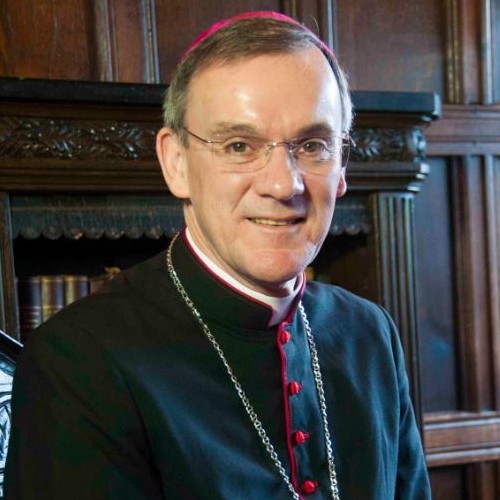
Bishop John Arnold
Bishop John Arnold · Lead Bishop for Communications, Catholic Bishops' Conference of England and Wales
Magisterium AI

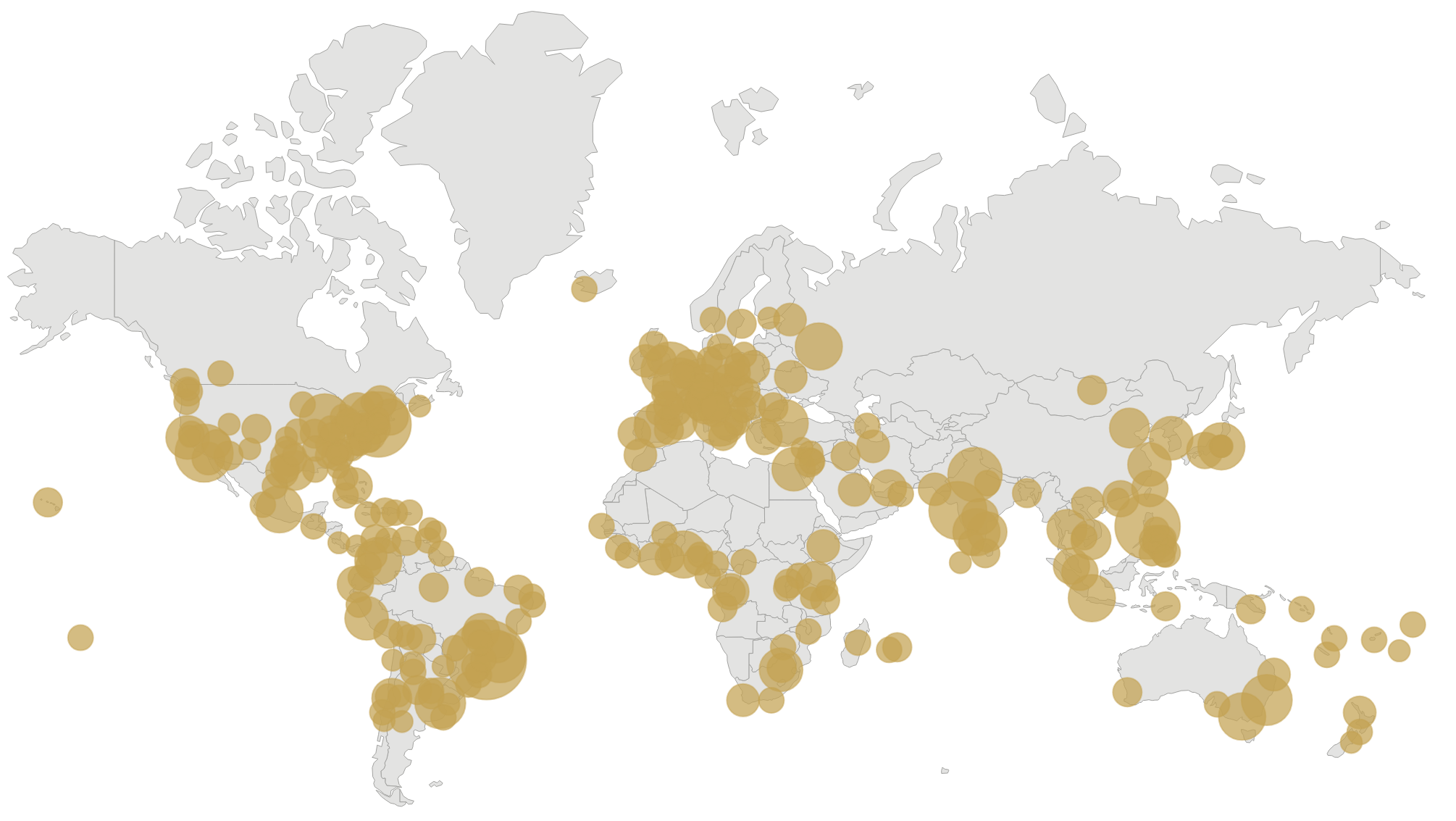
Who is using Magisterium AI

World map {{ mapDots }}
190+
Countries
75+
Languages
1,000,000+
Users
32,000+
Documents
Magisterium AI

Why it's reliable

Magisterium AI
ChatGPT Gemini Claude Meta AI
Source

Magisterium, Scripture, Church Doctors & Fathers.

Open internet.

Citations

Full, verifiable references on every answer.

Often absent or unreliable.

Accuracy

High fidelity to Catholic teaching.

Inconsistent.

Behind every answer is the largest vector database of Church teaching in the world, able to be queried in any language.

Years of purpose-built tools, some updated daily, assemble context from that library before a question is answered.

521,280 points of the Church's teaching, arranged by meaning.
Magisterium AI

How it works

01
Search

Your query searches a vetted library of Magisterial and Catholic theological and philosophical texts.

02
Retrieve

Magisterium finds the most relevant, authoritative passages and extracts them.

03
Synthesize

It reviews the extracted passages and uses them to ground the generation of its answer, cited back to each source.
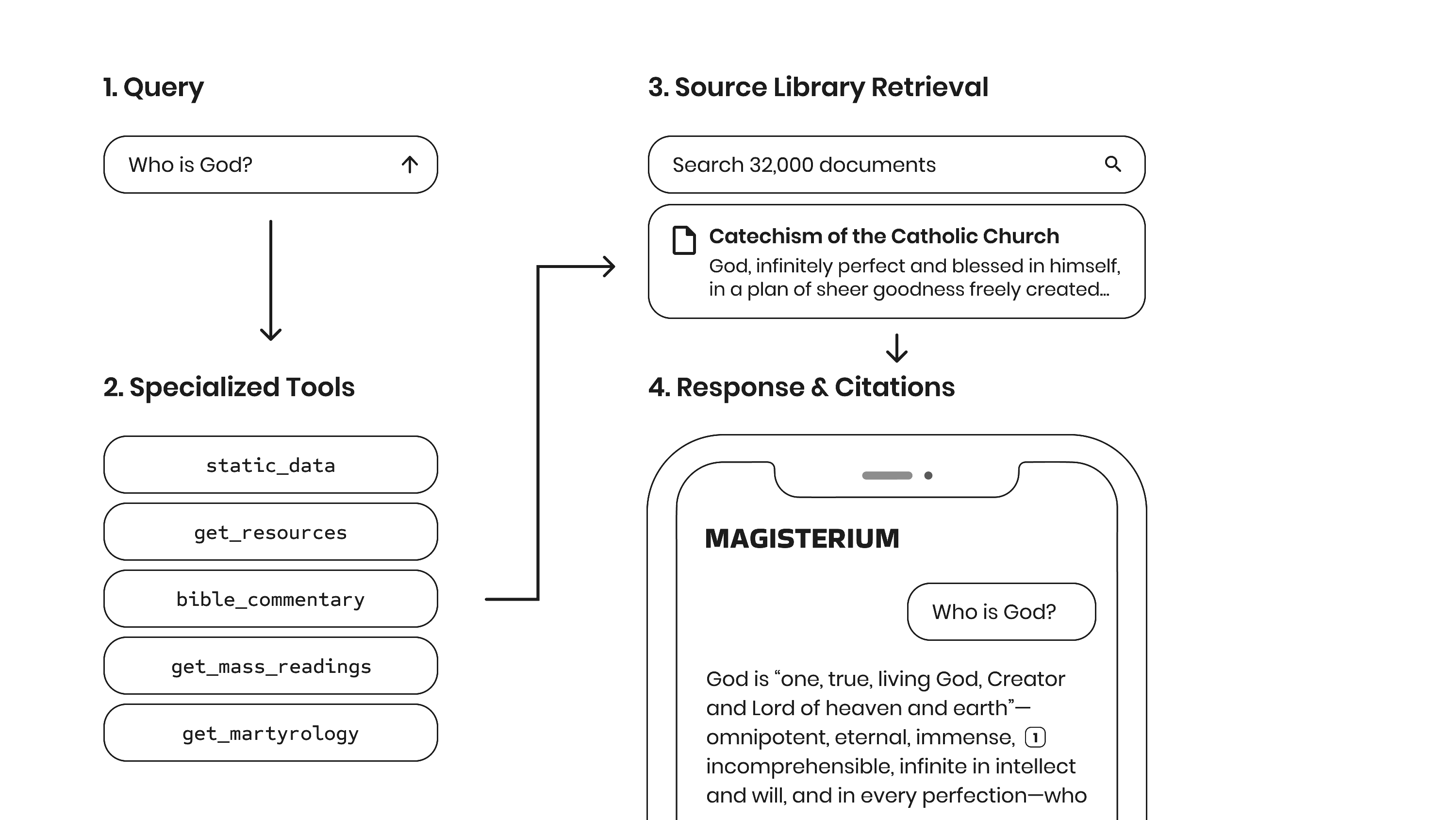
Magisterium AI: how it works. Query, specialized tools, source library retrieval, response and citations
Questions the faithful bring to Magisterium AI

“Why does God allow us to suffer?”

“What is the purpose of life?”

“Explain the significance of St. Thomas Aquinas’ ‘Summa Theologica’”

“Help me develop a teaching module on Church martyrs”

Magisterium AI

What it can do

Each of these tools is available on Magisterium AI today.

Explore

  • Biblical Commentary
  • Daily Mass Readings, Order of Mass & other Holy Widgets
  • Saints Database
  • Ecclesiastical Directory
  • Diocesan Financial Records
  • Spiritual Statistics by Diocese
  • Catholic News

Tools

  • Built-in Document Viewer
  • Source Library
  • My Library
  • Learn Mode
  • Thinking Mode
  • Canvas Mode
  • Upload Documents
  • Voice Mode
  • Audiobooks

Apps & Integrations

  • Connectors for Claude, ChatGPT, Grok, Hermes Agent & OpenClaw
  • iOS & Android apps
  • WhatsApp Integration
  • API & MCP for Developers
  • A2A Protocol
Vulgate
Vulgate

Your data. Structured. Searchable. Citable.

Vulgate turns static “dark data” from text, images, audio and video into structured, searchable, queryable data through one automated AI pipeline, preserving source fidelity.

Every answer is cited to its exact source, faithful to the original, and translatable into 29+ languages, while the archive stays entirely the diocese’s own.

Inside Vulgate: a digitized source document open beside the Assistant, which answers and summarizes grounded in the institution's own archive.

Vulgate

What it can do

The AI tools behind Vulgate, put to the everyday work of a diocese: finding what you hold, understanding it, and making it usable.

Chat with your Library

Ask a question and get an instant answer, complete with citations and footnotes.

Neural & keyword search

Neural search understands meaning and intent across languages; keyword search gives exact matches.

AI-powered resource ingestion

NLP, Computer Vision, and Document AI convert your collections into structured, searchable data.

AI assistant

Reach AI on every page to summarize, analyze, or translate a document without leaving your work.

Machine translations

High-quality translation of text and speech into 29+ languages, built in, no external tools.

Personal Library

Each user can save key texts and share excerpts with colleagues.

Faithful to the source

Page noise removed and OCR corrected, so the text reflects the original.

page 12verbatim

Structure kept intact

Headings, sections, footnotes, and metadata stay preserved in TEI XML, not flattened to plain text.

<text> <head>…</head> <div n="1"> <p>…</p> </div> </text>

Every answer cited

AI answers link to the exact source passage, with footnotes you can open and verify.

[1]
Source · Liber I, cap. 1
Alexandria Digitization Hub

Established in partnership with the Pontifical Gregorian University, the Alexandria Digitization Hub exists to preserve and universalize the patrimony of the Church.

From Rome, we are digitizing the libraries of the Pontifical Universities, expanding the Catholic dataset at 2,500 pages per hour.

Everything the Hub digitizes becomes accessible to everyone through Magisterium AI and Vulgate, anywhere in the world.

In partnership with Pontifical Gregorian University
The Robo Scan machines in operation, Pontifical Oriental Institute.
What's Next
Ephrem

The world's first Catholic Language Model.

Ephrem brings the Church's voice into the model itself, not only into the answers.

Ephrem is a Specialized Language Model built to offer deep insight into the teaching of the Catholic Church, with a theological accuracy and consistency that generic AI models cannot guarantee.

It offers a trusted, faith-aligned companion for Catholics seeking guidance, education, or dialogue in an increasingly secular world.

Ephrem is currently in the research phase, the next stage of Longbeard's work.

Getting Started

One program

The Diocesan Partnership Program brings it all together: your records digitized, Magisterium AI localized with them, and Catholic Intelligence informing what comes next.

The next step is a live demonstration, with your own questions.

Program pricing
$1,083 / month
$12,999 per year · billed annually or monthly

The Diocesan Package.

Free for dioceses under $5 million in annual revenue.

Request a demo.

Partnerships
Benjamin Crockett
Longbeard Put your diocese's knowledge to work in service of mission